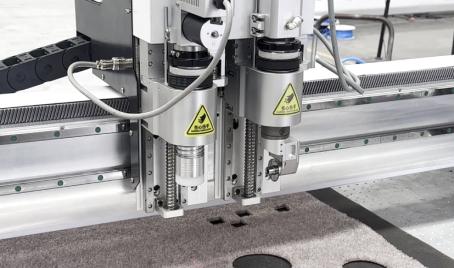
When cutting soft PET fiber materials, adding more pressure does not always improve cutting quality.
In a recent M.RISE CNC digital cutting test, the same PET fiber material was processed using the same driven rotary blade under two different conditions:
Test 1: Rotary blade without a pressure plate
Test 2: Rotary blade with a pressure plate
The cutting results were visibly different.
Without the pressure plate, the rotary blade moved through the material more smoothly and produced a cleaner, more stable cut.
When the pressure plate was added, the lightweight PET fiber material was more easily pulled, lifted and disturbed during cutting, resulting in poorer cutting stability and less consistent edge quality.
Watch the Real PET Fiber Cutting Test
The following M.RISE cutting test compares the same PET fiber material using the same driven rotary blade under two different conditions: with a pressure plate and without a pressure plate.
Watch the real cutting behavior before we explain why the results are different.
As shown in the test, adding the pressure plate causes the lightweight PET fiber material to lift and move during cutting, while removing the pressure plate allows the rotary blade to cut more smoothly and consistently. The following sections explain the mechanical reasons behind this difference and how to select the correct cutting process for PET fiber materials.
This comparison shows that cutting quality depends not only on tool selection, but also on how the material is restrained during processing. For soft, fluffy and fibrous materials, the fixation method can be just as important as the blade itself.
Why Can a Pressure Plate Make PET Fiber Cutting Worse?
A pressure plate is normally used to stabilize material close to the cutting area.
For many materials, this can improve cutting accuracy.
However, PET fiber batting and soft polyester insulation materials behave differently from rigid sheets.
These materials are:
- lightweight
- compressible
- elastic
- fibrous
- relatively easy to deform
- sensitive to local friction and surface restraint
When a pressure plate presses directly on this type of material, several problems can occur.
1. Excessive Compression Changes the Material Structure
PET fiber batting is made from a loose network of polyester fibers.
When the material is not heavily compressed, the rotary blade can separate the fibers progressively as it rolls forward.
With a pressure plate, however, the fibers can be compressed into a denser cutting zone.
This increases the resistance experienced by the blade and may cause:
- material dragging
- uneven feeding
- edge distortion
- incomplete cutting in some areas
- increased blade load
For this reason, a pressure plate that works well on dense materials may not produce the same result on soft insulation fiber.
2. Surface Friction Can Cause Material Lifting
The M.RISE test clearly showed that the material became less stable when the pressure plate was used.
One likely reason is increased surface friction.
As the cutting head moves, the pressure plate remains in contact with the material surface. On soft PET fiber, this contact can create additional drag.
Instead of simply holding the material flat, the plate may slightly push, pull or disturb the upper fiber layers.
This can cause the material to rise around the cutting area.
Once the material starts lifting, cutting accuracy and edge quality become less consistent.
3. Rotary Blades Work Best With Continuous Slicing Motion
A driven rotary blade cuts by rolling through the material.
This is very different from a drag knife or a conventional oscillating knife.
The rolling blade continuously changes the cutting contact point, which helps reduce lateral pulling and makes it especially suitable for many soft and fibrous materials.
For PET fiber batting, this rolling action can work very efficiently when the material is allowed to remain relatively relaxed.
If the material is excessively restrained from above, the natural rolling and slicing action can be disturbed.
That is why, in this test, the rotary blade produced a better result without the pressure plate.
4. More Pressure Does Not Always Mean Better Cutting
This is one of the most important lessons from the test.
In CNC digital cutting, many users assume that stronger material compression always improves stability.
That is not true for every material.
For soft PET fiber, polyester insulation cotton and similar acoustic insulation materials, too much pressure can actually create additional cutting problems.
The correct process depends on:
- material thickness
- material density
- fiber structure
- surface friction
- blade diameter
- blade sharpness
- cutting speed
- vacuum strength
- pressure plate design
This means cutting quality depends on the complete process, not on one tool alone.
Rotary Blade vs. Oscillating Knife for PET Fiber
Both rotary blades and oscillating knives can be used for polyester fiber materials, but they are suitable for different conditions.
Driven Rotary Blade
A rotary blade is often a good choice for:
- soft PET fiber batting
- polyester insulation cotton
- textile-like fiber materials
- soft acoustic insulation layers
- thin or medium-thickness flexible fiber sheets
Its main advantage is low lateral drag.
The rotating blade creates a continuous slicing action, which can help reduce fiber pulling and material deformation.
Oscillating Knife
An oscillating knife can be better for:
- thicker PET felt
- dense polyester fiber acoustic panels
- rigid or semi-rigid acoustic boards
- complex contour cutting
- deeper cutting paths
- applications requiring straight cuts, slots or detailed geometry
For thick acoustic panels, oscillating knife cutting may provide stronger penetration and better control.
The important point is that there is no single “best tool” for every PET material.
The correct choice depends on the physical structure of the material and the required finished part.
Vacuum Adsorption Can Be Better Than Top Pressure
For lightweight fiber materials, M.RISE often relies on vacuum adsorption from below instead of applying excessive pressure from above.
A vacuum table can help:
- keep the material flat
- reduce lateral movement
- avoid excessive fiber compression
- stabilize the cutting area
- improve cutting consistency
This type of material fixation is particularly useful for soft insulation, felt and fiber-based materials.
In many applications, the combination of:
vacuum table + driven rotary blade
can provide better results than:
pressure plate + rotary blade
especially when the material is soft and easily deformed.
Real Material Testing Is Important
PET fiber materials vary significantly between manufacturers.
Two materials that look similar may have very different:
- densities
- fiber structures
- hardness
- thickness
- surface friction
- compression behavior
This is why M.RISE recommends real material testing before final machine configuration.
During testing, different tool combinations can be evaluated, including:
- driven rotary blade
- oscillating knife
- pneumatic knife
- pressure foot
- no pressure plate
- vacuum-only fixation
- different cutting speeds
- different blade types
The purpose is not simply to cut the material.
The purpose is to find the process that delivers the most stable and repeatable production result.
Which Industries Use PET Fiber Cutting Machines?
PET fiber and polyester insulation materials are widely used in:
- acoustic panel manufacturing
- sound insulation
- automotive interiors
- HVAC insulation
- building insulation
- industrial noise control
- decorative acoustic products
- furniture and interior design
- protective fiber packaging
For manufacturers in these industries, cutting quality directly affects the appearance, fit and final performance of the product.
A suitable PET fiber cutting machine therefore needs more than cutting power.
It also needs the correct combination of:
tool + blade + fixation method + cutting parameters
M.RISE PET Fiber Cutting Solutions
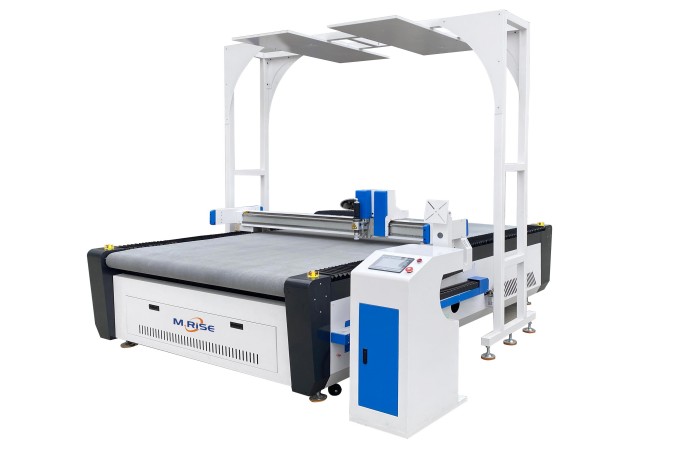
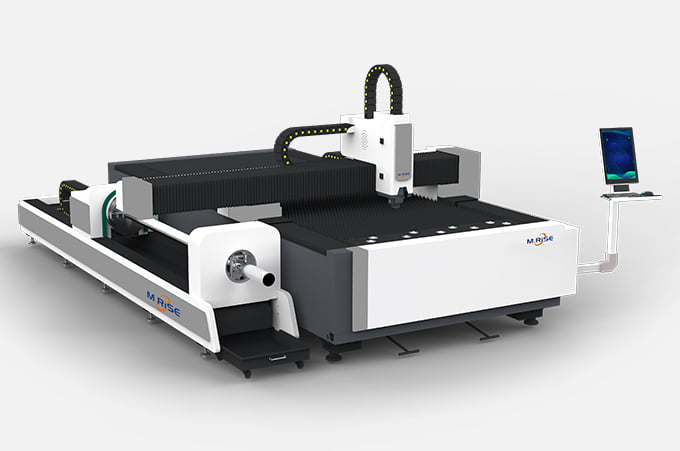
M.RISE provides CNC digital cutting solutions for PET felt, polyester fiber, acoustic insulation materials and other flexible materials.
Depending on the application, the system can be configured with:
- driven rotary blade
- electric oscillating knife
- pneumatic knife
- V-cut tool
- creasing tool
- milling spindle
- multi-tool cutting heads
- vacuum adsorption table
This allows manufacturers to adapt the machine to different PET fiber structures, thicknesses and cutting requirements.
The goal is not to force one tool to process every material.
The goal is to select the right cutting process for the actual application.
PET Fiber Cutting Test Conclusion
The M.RISE comparison test demonstrated a simple but important result:
Same PET fiber material. Same rotary blade. Different cutting results.
With a pressure plate, the material was more likely to lift and become unstable.
Without the pressure plate, the rotary blade produced a cleaner and smoother cutting result.
The lesson is clear:
More pressure does not always mean better cutting.
For soft PET fiber and polyester insulation materials, reducing unnecessary surface restraint can sometimes improve cutting stability and edge quality.
Manufacturers should evaluate material behavior before selecting the cutting tool and fixation method.
Need a PET Fiber Cutting Solution?
If you are cutting:
- PET fiber batting
- polyester insulation cotton
- PET acoustic felt
- sound insulation material
- acoustic panels
- flexible fiber materials
M.RISE can test your actual material and recommend the suitable cutting tool, blade and machine configuration.
Send us your material name, thickness, sheet size, sample photo, cutting drawing and required production capacity.
Based on your application, our engineers can recommend a suitable PET fiber and acoustic panel cutting machine configuration, including the appropriate rotary blade, oscillating knife and material fixation method.
Request a PET Fiber Cutting Test →