Does a Coil-Fed Laser Blanking Line Need NR-12 Compliance in Brazil?
Yes. A coil-fed laser blanking line imported, installed and operated in Brazil must be evaluated against the applicable Brazilian occupational safety requirements.
NR-12 is the principal Brazilian regulation governing safety at work with machinery and equipment. For an automated coil-fed laser blanking line, compliance should address the complete integrated production system—not only the fiber laser cutting machine.
A typical line may include:
- Automatic coil loading
- Decoiline
- Precision leveling
- Servo feeding
- Fiber laser cutting
- Conveyor or transfer systems
- Robotic unloading
- Automatic sorting and stacking
- Optional downstream bending automation
Each section introduces different mechanical, electrical, laser, pneumatic, hydraulic and operational hazards. Effective safety engineering therefore requires a system-level approach covering the machinery, control architecture, documentation and final installation environment.
NR-12 is a Brazilian regulatory requirement. It is not a worldwide certification and should not be treated as equivalent to CE conformity in the European Union or machinery safety requirements in the United States and other markets.
What Is NR-12?
NR-12, officially titled Segurança no Trabalho em Máquinas e Equipamentos, establishes safety requirements for machinery and equipment used in Brazilian workplaces.
Its purpose is to define technical references, fundamental principles and protective measures intended to safeguard the health and physical integrity of workers throughout the life cycle of machinery.
Its scope extends beyond normal machine operation. Depending on the project, safety must be considered during:
- Design and engineering
- Manufacture
- Importation
- Transportation and installation
- Commissioning
- Operation
- Setup and adjustment
- Cleaning and inspection
- Maintenance and troubleshooting
- Modernization
- Decommissioning
NR-12 applies to both new and existing machinery. Equipment imported into Brazil cannot normally rely solely on a foreign certificate or a manufacturer’s general declaration. The actual machine configuration, safety functions, documentation and final installation must be considered.
The current official text and supporting publications are available from the Brazilian Ministry of Labour and Employment NR-12 portal.
Is NR-12 Required Worldwide?
No. NR-12 belongs specifically to the Brazilian occupational safety system.
Other markets apply their own legal frameworks:
| Market | Principal machinery safety framework |
|---|---|
| Brazil | NR-12 and other applicable Brazilian Regulatory Standards |
| European Union | CE conformity under applicable EU machinery, electrical and EMC legislation |
| United States | OSHA requirements, supported by relevant ANSI, NFPA and local requirements |
| Canada | Provincial occupational safety legislation, CSA standards and applicable electrical approval |
| Other markets | National legislation supported by applicable ISO and IEC standards |
A machine designed according to recognized international standards may provide a strong engineering foundation, but international standards do not automatically replace Brazilian regulatory obligations.
Likewise, NR-12 documentation for Brazil does not automatically establish conformity in Europe, North America or another destination market.
Why Must the Complete Production Line Be Assessed?
A coil-fed laser blanking line functions as an integrated manufacturing system.
The individual machines exchange material, operating commands, status signals and safety information. A hazard in one section may therefore affect another part of the line.
For example:
- Opening an access door near the leveler may need to stop the leveler, feeder and upstream decoiler.
- A fault in the robotic unloading area may need to prevent the laser cutting cycle from releasing another finished part.
- A loss of vacuum pressure may create a dropped-load risk during robotic handling.
- A reset command must not restart machinery while a person remains inside a safeguarded area.
- Maintenance on the laser machine may require isolation of electrical, pneumatic, hydraulic and mechanical energy from adjacent equipment.
Assessing only the laser cutting machine would leave these interfaces insufficiently addressed. Safety should therefore be evaluated across the entire workflow:
Coil loading → Decoiling → Leveling → Servo feeding → Laser cutting → Robotic unloading → Sorting and stacking
If an automated bending system is integrated downstream, its crushing and forming hazards must also be included in the system assessment.
Key Hazards in a Coil-Fed Laser Blanking Line
1. Coil Loading and Decoiling
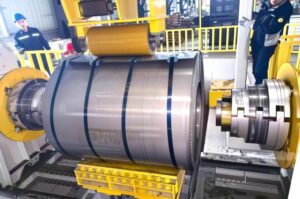
Metal coils contain considerable mass and stored energy. Relevant hazards may include:
- Coil movement or collapse
- Crushing during loading
- Rotation of the mandrel
- Entanglement with moving components
- Sudden release of the strip
- Sharp metal edges
- Unexpected movement of the coil car or hold-down arm
Depending on the machine design and risk assessment, protective measures may include guarded operating areas, controlled coil loading procedures, mechanical restraints, safe setup modes, restricted access and appropriate energy-isolation points.
2. Leveling and Servo Feeding
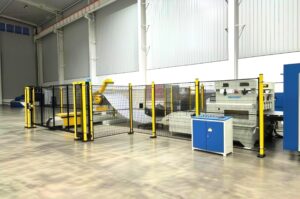
Levelers and feeders contain multiple powered rollers and transmission components.
Principal risks include:
- Drawing-in and entanglement at roller infeed points
- Crushing between leveling rollers
- Contact with gears, chains or shafts
- Unexpected strip movement
- Sharp-edge injuries
- Stored pneumatic or hydraulic energy
Protective measures may include fixed guards, interlocked access covers, safeguarded infeed areas, safety-rated stopping functions and controlled setup or maintenance modes.
3. Fiber Laser Cutting
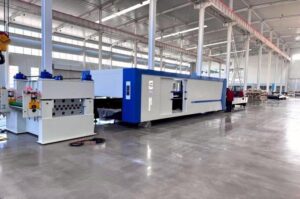
The laser cutting section introduces a different combination of hazards:
- Direct or reflected laser radiation
- Cutting fumes and airborne contaminants
- Fire
- Hot parts and molten material
- High-pressure cutting gases
- Powered machine axes
- Electrical hazards
An industrial laser blanking system commonly requires an enclosed cutting area, interlocked access points, suitable viewing windows, fume extraction, gas monitoring and fire-risk controls appropriate to the material and process.
Laser classification and protective measures should be determined using the applicable technical standards and project-specific risk assessment.
4. Robotic Unloading
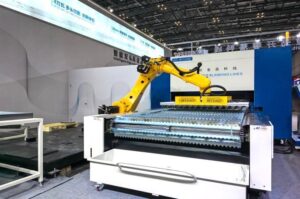
Robotic unloading improves productivity but creates a controlled hazardous zone.
Possible risks include:
- Collision with the robot
- Crushing between the robot and fixed structures
- Unexpected robotic movement
- Loss of vacuum during handling
- Falling sheet-metal parts
- Entry into the robot cell during automatic operation
The safeguarding concept may use perimeter fencing, interlocked gates, safety scanners, light curtains, monitored vacuum systems and safety-related robot functions.
Access points must be designed so that entering the safeguarded area produces the required safe response. Restart should require deliberate action after confirming that no person remains within the hazardous zone.
5. Part Handling and Stacking
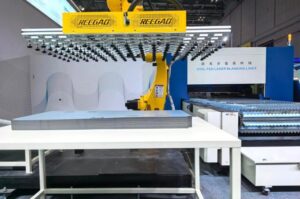
Finished parts may have sharp edges, irregular shapes and considerable weight.
The stacking system should consider:
- Dropped parts
- Unstable stacks
- Pinch and crushing points
- Robot reach into operator areas
- Manual removal and handling
- Safe access for pallet replacement
The stacking arrangement should be evaluated according to the dimensions, weight, geometry and surface condition of the parts being produced.
6. Optional Bending Automation
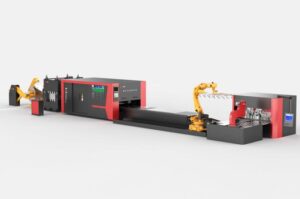
If a press brake or automated bending system is integrated with the line, additional forming-zone hazards must be assessed.
These may include:
- Crushing between the tooling
- Movement of back gauges
- Robot interaction with the bending machine
- Material movement during bending
- Access for setup and tool replacement
- Automatic transfer between cutting and bending
The bending system should not be treated simply as another conveyor station. It requires safeguards appropriate to its own high-risk forming operation.
What Safety Measures May Be Required?
The final safety concept must be based on a documented risk assessment. Depending on the configuration, the following measures may form part of the project:
Physical guarding
- Perimeter safety fencing
- Fixed guards
- Interlocked access doors
- Guarded rollers, shafts and transmission components
- Restricted access to laser and robot areas
Safety-related control functions
- Emergency-stop circuits
- Safety relays or safety PLC architecture
- Monitored guard-door interlocks
- Safe stopping functions
- Prevention of unexpected startup
- Manual reset after a safety stop
- Safety-zone monitoring
- Controlled setup and maintenance modes
Presence detection
- Safety light curtains
- Laser scanners
- Pressure-sensitive devices
- Access monitoring
- Robot-cell intrusion detection
- The type and positioning of each device must reflect the actual hazard, stopping performance and required safety distance.
Energy isolation
A production line may contain several energy sources:
- Electrical power
- Hydraulic pressure
- Pneumatic pressure
- Mechanical stored energy
- Gravity
- Rotating components
- Thermal energy
Isolation points should be identifiable, accessible and capable of supporting safe maintenance procedures. A lockable main isolator alone may not control every form of stored energy within the line.
Safety information
Required safety information may include:
- Operating instructions
- Setup procedures
- Maintenance instructions
- Residual-risk warnings
- Lockout procedures
- Emergency procedures
- Safety labels
- Machine identification
- Training requirements
Instructions and warnings intended for operators in Brazil generally need to be available in Brazilian Portuguese.
How Do NR-10, NR-15 and NR-17 Relate to the Production Line?
NR-12 is central to machinery safety, but it does not operate in isolation.
NR-10: Electrical Safety
NR-10 addresses safety in electrical installations and services.
For a coil-fed laser blanking line, relevant areas may include:
- Main electrical supply
- Electrical cabinets
- Grounding and protective bonding
- Electrical isolation
- Cable routing
- Protection against electric shock
- Electrical maintenance
- Authorized personnel and working procedures
The project should be checked against the version of NR-10 in force at the time of installation and commissioning. The official information is available from the Brazilian Ministry of Labour and Employment NR-10 portal.
NR-15: Occupational Exposure
NR-15 addresses activities and operations involving occupational exposure to physical, chemical and biological agents.
For a laser blanking line, evaluation may be relevant to:
- Noise from decoiling and leveling
- Cutting fumes
- Airborne metal contaminants
- Heat
- Vibration
- Non-ionizing radiation, including laser exposure
The applicability of individual NR-15 provisions depends on the actual working environment and exposure assessment. Additional information is available from the official NR-15 portal.
NR-17: Ergonomics
NR-17 addresses the adaptation of working conditions to the characteristics of workers.
Relevant aspects may include:
- HMI and control-panel position
- Operator visibility
- Access to controls
- Manual loading and unloading
- Pallet replacement
- Maintenance access
- Working posture
- Material-handling requirements
- Lighting and workplace organization
Ergonomic assessment should reflect the actual tasks carried out by operators and maintenance personnel. See the official NR-17 information.
Depending on the installation and work activities, other Brazilian Regulatory Standards may also apply. These requirements should be identified during the project-specific assessment.
Is NR-12 a Conventional Product Certificate?
NR-12 is more accurately understood as a machinery safety regulation than as a conventional global product-certification scheme.
The expression “NR-12 certificate” is often used commercially, but meaningful conformity normally involves more than a single certificate.
A complete process may include:
- Risk assessment
- Definition of required protective measures
- Review of the safety control system
- Safety circuit diagrams
- Machine identification
- Technical documentation
- Portuguese manuals and warnings
- Verification of safeguards
- Validation testing
- Inspection of the final installation
- Technical records issued or reviewed by qualified Brazilian professionals
The existence of a generic document does not, by itself, prove that the complete production line is compliant in its final operating environment.
Does Each Production Line Require an Individual Assessment?
A standard machine design can reuse established engineering documentation, validated safety concepts and risk-assessment methods.
However, each installed line may differ in:
- Model and serial number
- Coil dimensions and weight
- Material thickness
- Production speed
- Laser power
- Robot type and reach
- Loading and unloading arrangement
- Factory layout
- Operator access
- Downstream automation
- Electrical supply
- Local interfaces
These differences may affect the safeguarding concept.
For this reason, the final assessment and validation should correspond to the actual production line and installation. Two lines based on the same design may share documentation, but each installation still needs to be checked against its final configuration.
What Documentation Should Be Prepared?
A professional technical documentation package may include:
- Machine and production-line description
- Model and serial-number information
- Layout and safeguarded-area drawings
- Electrical schematics
- Pneumatic and hydraulic diagrams
- Safety circuit architecture
- Risk assessment
- Safety-function list
- Validation records
- Emergency-stop zoning
- Interlock specifications
- Operating manual
- Maintenance manual
- Energy-isolation instructions
- Portuguese warning labels
- Training records
- Inspection and test documentation
Documents must accurately reflect the delivered machine. Generic manuals that omit installed options, robot interfaces or safety functions may be insufficient for the final project.
International Standards Supporting Safety Engineering
Recognized international standards can support the design and validation process. Depending on the production-line configuration, relevant references may include:
- ISO 12100 for machinery risk assessment and risk reduction
- ISO 13849-1 and ISO 13849-2 for safety-related control systems
- IEC 60204-1 for electrical equipment of machines
- ISO 13850 for emergency-stop functions
- ISO 14119 for interlocking devices
- ISO 14120 for guards
- ISO 10218 for industrial robots and robotic systems
- IEC 60825-1 for laser product safety
- ISO 11553 for laser processing machine safety
The appropriate Brazilian ABNT editions and project-specific standards should be confirmed by the responsible professionals.
Using internationally recognized engineering standards can strengthen the technical foundation of the machine, but it does not eliminate the need to assess Brazilian legal and workplace requirements.
How MRISECNC Supports Brazilian Production-Line Projects
MRISECNC provides configurable coil-fed laser blanking solutions for industrial sheet-metal processing.
A project can be developed around:
- Coil material and grade
- Coil width and thickness
- Coil weight
- Part dimensions
- Required production capacity
- Laser power
- Nesting requirements
- Robotic unloading
- Part sorting and stacking
- Factory layout
- Destination-market safety requirements
Depending on the project, the production line can incorporate perimeter guarding, interlocked access doors, emergency-stop systems, enclosed laser cutting, fume extraction, safety-related controls and robotic-cell protection.
Safety requirements should be identified during the engineering stage rather than considered only after the equipment has been completed. Early coordination helps integrate protective measures into the machine architecture, layout and control system.
Final Brazilian conformity must be determined according to the delivered configuration and installation conditions, with assessment and validation by appropriately qualified professionals in Brazil.
Frequently Asked Questions
1. Is NR-12 required for machinery imported into Brazil?
- Machinery imported for installation and operation in Brazilian workplaces must be evaluated against the applicable Brazilian safety requirements. NR-12 is the principal regulation governing machinery and equipment safety.
2. Is NR-12 required outside Brazil?
- No. NR-12 is a Brazilian regulation. Machinery supplied to other countries must comply with the legal requirements of the destination market.
3. Is NR-12 the same as CE certification?
- No. NR-12 and CE conformity belong to different legal systems. CE documentation does not automatically establish NR-12 compliance, and NR-12 documentation does not replace EU conformity requirements.
4. Should the laser cutter be assessed separately from the production line?
- The laser machine may have its own safety documentation, but the final assessment should also cover its interfaces with the decoiler, leveler, feeder, robot, conveyor and stacking system.
5. Are Portuguese manuals required?
- Safety information intended for the Brazilian workplace should generally be provided in Brazilian Portuguese. Manuals, warnings and operating instructions must accurately represent the delivered equipment.
6. Is on-site validation required?
- The final installation can introduce risks that are not visible during factory production, including layout, access, electrical connection and interaction with surrounding equipment. Final on-site review is therefore an important part of the compliance process.
7. Can MRISECNC configure safety systems for a Brazilian project?
- MRISECNC can configure machinery safeguards and safety functions according to the technical requirements identified for the project. Final conformity should be assessed according to the actual installed line and applicable Brazilian requirements.
Conclusion
A coil-fed laser blanking line is not a single isolated machine. It is an integrated automated system combining heavy coil handling, powered rollers, servo feeding, laser processing, robotic movement and finished-part handling.
For projects in Brazil, NR-12 should be considered from the early engineering stage. The safety strategy must address the complete production workflow, machine interfaces, control system, documentation and installation environment.
By combining project-specific risk assessment, appropriate safeguards, recognized engineering standards and final local validation, manufacturers can build a safer and more reliable automated sheet-metal production process.
MRISECNC supports global manufacturers with configurable coil-fed laser blanking solutions for automotive components, HVAC systems, electrical enclosures, household appliances and other sheet-metal applications.
For a customized production-line proposal, provide MRISECNC with your coil material, thickness, width, coil weight, part drawings, required output, factory layout and destination country.
Production line information:
https://www.mrisecnc.com/coil-laser-cutting-production-line/
This article provides general technical information and does not constitute legal advice or a final declaration of NR-12 conformity. Applicable requirements should be confirmed for the specific machine and installation by appropriately qualified professionals in Brazil.
– [Brazilian Regulatory Standards – Ministry of Labour and Employment] (https://www.gov.br/trabalho-e-emprego/pt-br/assuntos/inspecao-do-trabalho/seguranca-e-saude-no-trabalho/ctpp-nrs/normas-regulamentadoras-nrs)
– [NR-10 – Safety in Electrical Installations and Services](https://www.gov.br/trabalho-e-emprego/pt-br/acesso-a-informacao/participacao-social/conselhos-e-orgaos-colegiados/comissao-tripartite-partitaria-permanente/normas-regulamentadora/normas-regulamentadoras-vigentes/norma-regulamentadora-no-10-nr-10)
– [NR-12 – Safety at Work with Machinery and Equipment](https://www.gov.br/trabalho-e-emprego/pt-br/acesso-a-informacao/participacao-social/conselhos-e-orgaos-colegiados/comissao-tripartite-partitaria-permanente/normas-regulamentadora/normas-regulamentadoras-vigentes/norma-regulamentadora-no-12-nr-12)
– [NR-15 – Unhealthy Activities and Operations](https://www.gov.br/trabalho-e-emprego/pt-br/acesso-a-informacao/participacao-social/conselhos-e-orgaos-colegiados/comissao-tripartite-partitaria-permanente/normas-regulamentadora/normas-regulamentadoras-vigentes/norma-regulamentadora-no-15-nr-15)